

Weight Loss Clinic in Taichung
Weight gain has more than one cause. We start with blood work and a metabolic assessment to find the main factor, then discuss medication, localised fat treatment and changes to diet and daily routine, with follow-up over time.

Common Weight Concerns
Weight gain that looks the same can have different causes, and the cause decides the approach. These six are what we see most often.
A Slower Metabolism
Age, muscle mass, daily routine and past crash diets all affect your basal metabolic rate. When it drops, weight can creep up even without eating more.
High Body Fat, Low Muscle
Weight within the normal range but body fat high and muscle low, so the body looks soft and metabolism is inefficient. Here body composition matters more than weight.
Visceral Fat and Metabolic Syndrome
A rising waistline and visceral fat, often alongside abnormal blood sugar, lipids or blood pressure. This kind of weight gain is a health issue, not only an appearance one.
Repeated Regain
Losing weight quickly then gaining it back, sometimes ending heavier than before. Usually linked to losing weight too fast, losing muscle, and eating habits that never changed.
Hormonal and Lifestyle Factors
Postpartum, menopause, stress and poor sleep can all affect appetite and where fat is stored. These need both endocrine and routine to be looked at together.
Losing Weight Too Fast
Rapid weight loss can bring hair shedding, fatigue and muscle loss. The pace and your nutrition need planning together, not just the number lost.
Learn more →When Should You See a Doctor?
Short-term fluctuation is normal, but the situations below are worth an assessment rather than an extreme diet or an unlabelled product.
You Can Adjust on Your Own
- Weight moving within one or two kilograms, with no change to waistline or shape
- A change caused by a short spell of irregular eating or sleep that settles once routine returns
- You only want to fine-tune your shape, with no chronic condition or medication
Worth Seeing a Doctor
- A BMI in the obese range, or a waistline that keeps increasing
- Losing and regaining repeatedly, and each round is harder than the last
- Weight gain alongside abnormal blood sugar, lipids, blood pressure or liver function
- A marked change after childbirth or menopause that will not reverse
- Losing a noticeable amount over a few months without trying to
The above is general health information and does not replace an in-person consultation; diagnosis and treatment require assessment by a qualified doctor.
Assessment and Treatment Options
Weight management means finding the cause first and choosing the tools second. The table sets out what this clinic actually offers and what each option suits.
| Option | Offered here | Worth discussing for | Points to note |
|---|---|---|---|
| Blood work and metabolic assessment | Yes | Finding blood sugar, lipid, thyroid or liver factors behind the weight | Fast for at least six hours; results are explained by the doctor before deciding what comes next |
| Diet and lifestyle changes | Yes | The basis of every case, and what keeps the weight off after medication stops | Takes time and consistency; results are not immediate |
| Oral medication | Yes, assessed case by case | Where medication is needed to help with appetite or fat absorption | Ingredients such as intestinal lipase inhibitors need indications and contraindications assessed; do not obtain them on your own |
| Injectable medication | Yes, assessed case by case | A BMI in range, metabolic abnormalities, or difficulty controlling appetite | Ingredients such as GLP-1 receptor agonists can cause digestive upset at first; the doctor adjusts the dose and follows up |
| Localised fat injections | Yes, after a feasibility assessment | Weight already improved but the chin or flanks still stand out | Does not replace overall weight loss; brief swelling is possible and recovery varies |
| Follow-up and adjustment | Yes | The maintenance phase and life after stopping medication | Weight, body fat and metabolic markers together tell you more than weight alone |
Response varies from person to person. This table is only to help you understand the options before your visit and is not a guarantee of results. All medication used is in original manufacturer packaging; we do not use repackaged or unlabelled preparations.
Assessment and Treatment
From tests through medication to lifestyle changes, combined according to the metabolic assessment and arranged after assessment by a doctor.

Blood Work and Metabolic Assessment
Blood sugar, lipids, thyroid and liver function are reviewed to find the metabolic factors behind the weight gain.

One-to-One Assessment
The doctor asks about your history, routine and past attempts, explains the results, and works out with you which tools to use and at what pace.

Injectable Medication and Education
Ingredients such as GLP-1 receptor agonists, given once weekly under the skin. A nurse demonstrates the technique, storage and the digestive effects to expect.

Oral Medication Assessment
Suitability is assessed against indications and contraindications, with regular follow-up of both effect and side effects.

Localised Fat Injections
Injections for fat that stands out at the chin or flanks. Suitability and the number of sessions are arranged after assessment by a doctor.

Diet and Lifestyle Management
Reviewing what and when you eat, and the effect of sleep, stress and activity. This is what decides whether the weight stays off.
This article is disease education information. It is not drug advertising and does not recommend or sell any specific medicine.
What a Visit Looks Like
Before your first visit
Allow 30 to 40 minutes. Fast for at least six hours so blood can be taken, and think about what you have tried before and where it went wrong.
History and metabolic tests
The doctor asks about your history, medication, routine and the causes of the weight gain, then arranges blood work and metabolic tests.
Results and a plan
The results are explained, along with the likely reasons, and you agree on a combination of medication, treatment and dietary change with an expected timeline.
Treatment and follow-up
Doses or intervals are adjusted to your response, while weight, body fat and metabolic markers are tracked together.
Maintenance
Once the target is reached the focus shifts to eating habits and metabolic stability, to reduce the risk of regain.
Our Weight Management Team
Care from obesity medicine specialists, with clinical backgrounds from National Taiwan University Hospital, Veterans General Hospital and other medical centres.

Dr. Tseng

Dr. Li
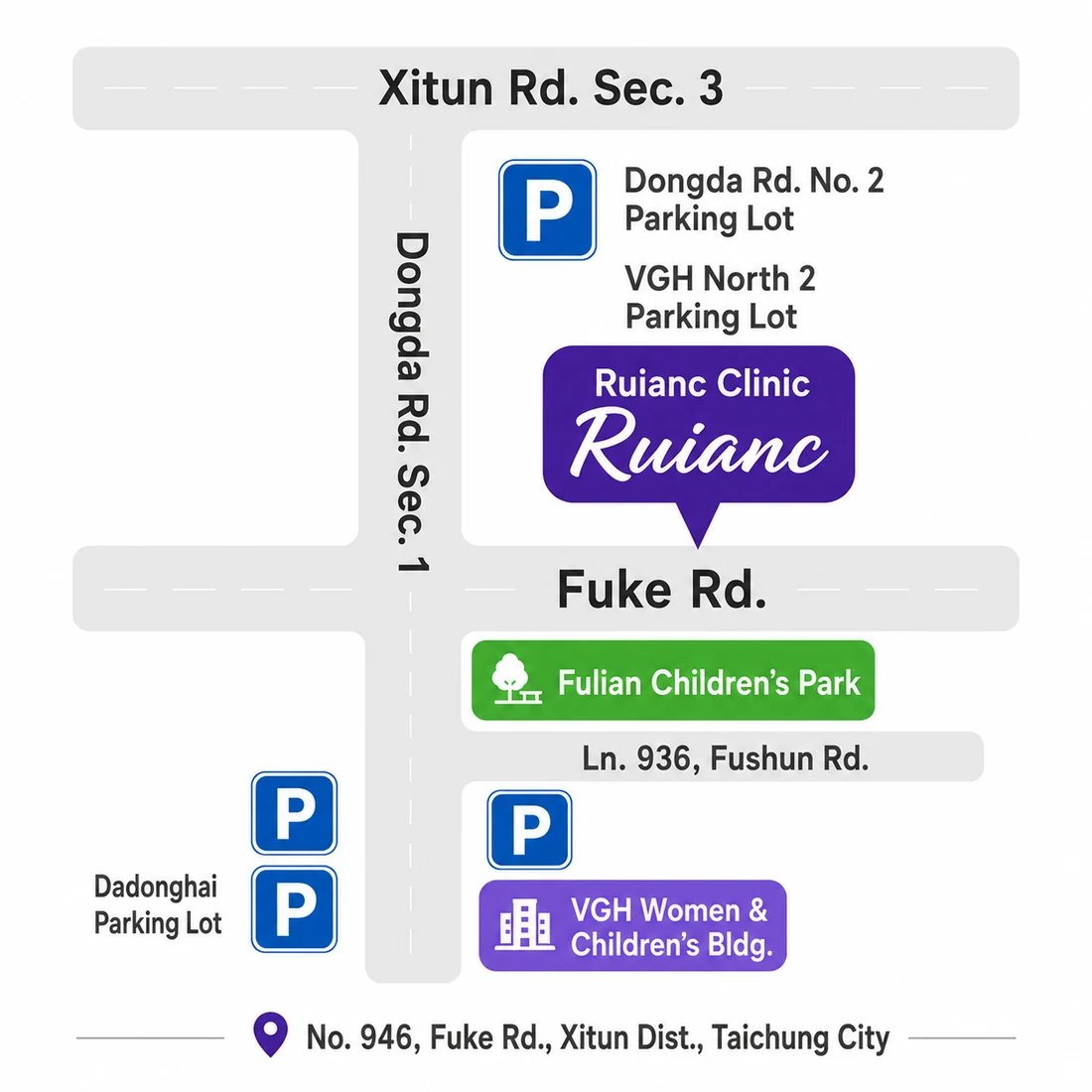
Location and Directions
Behind Taichung Veterans General Hospital・Near Central Taiwan Science Park・Ruilian Tiandi Block D
Saturday afternoon 13:15–17:00; closed Sunday. Latest registration 20:45; hours follow the weekly schedule.
Partner employers: AU Optronics・Winbond Electronics・Corning Taiwan・TSMC・ProMOS Technologies
Frequently Asked Questions
QDo I have to have injections? Can medication or diet alone work?
Not necessarily. Whether injectable medication is needed depends on BMI, metabolic status, appetite control and what you have tried before. Some people reach their goal with oral medication and dietary change, and the doctor will advise based on your results.
QDoes weight-loss medication have side effects?
Some people feel nauseous or bloated or notice appetite changes at first, usually temporary. The doctor adjusts the dose to your tolerance and follows up; if the effects are marked, come back and discuss rather than stopping on your own.
QWill I regain the weight after stopping?
If you rely on medication alone without changing diet and routine, regain is more likely. Metabolic management and behaviour change are part of the treatment precisely to reduce that risk.
QCan localised fat treatment replace weight loss?
No. It addresses fat in a specific area and suits people whose weight has already improved but whose contour has not. It does not replace overall weight and metabolic management.
QIs the clinic suitable after childbirth or menopause?
Yes. Those cases usually involve hormonal and metabolic change, which makes assessment more important, not less; dieting alone often has limited effect and rebounds easily.
QWhat should I prepare? Is blood work required?
Fast for at least six hours so blood can be taken. Blood work helps identify why the weight is rising and whether medication suits you, and it is the basis of a personalised plan. Bring details of any medication you take.
QHow long before I see results?
It varies with your starting point, the approach chosen and how consistently it is followed. The doctor adjusts the strategy as you go and looks at weight, body fat and metabolic markers together rather than the scale alone.
QDo I need to book in advance?
Booking is recommended. Phone and LINE bookings open 30 days before the clinic day and you can choose the doctor and time slot; walk-ins are also accepted, with the last registration at 20:45.