

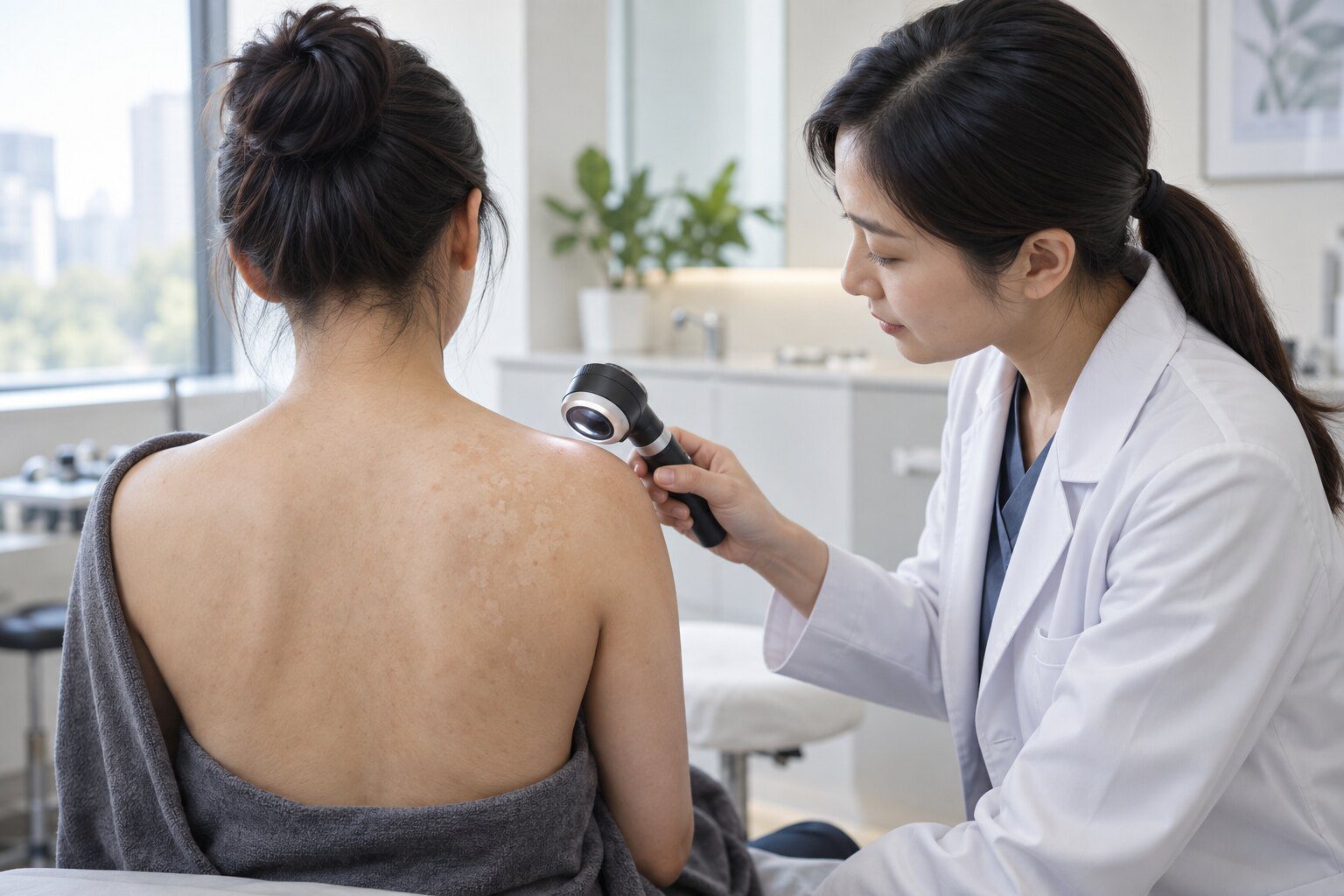
Lighter, darker or pink patches with fine scale on the chest, back, shoulders or neck may be tinea versicolor. It recurs more often in warm, humid conditions and with sweating, but it is not caused by poor hygiene and is not usually passed directly between people.
Colour varies with skin tone, sun exposure and inflammation, so it can resemble vitiligo or post-inflammatory pigment change. Once the diagnosis is clear, treatment controls yeast overgrowth; scale and skin colour do not recover at the same speed.
Key points: Tinea versicolor often affects the chest, back, shoulders and upper arms. Patches may be pale, darker or pink with fine scale. It is not usually contagious; colour can persist after treatment, while continuing scale, spread or recurrence needs review.
What is tinea versicolor and why does it occur?
Tinea versicolor is a superficial change caused when Malassezia yeast, normally present on healthy skin, grows more actively under certain conditions. Having it does not mean the skin is unclean.
Warmth, humidity, sweating, oilier skin and individual susceptibility may contribute. It is common in adolescents and young adults but can occur at other ages.
What are its symptoms and common sites?
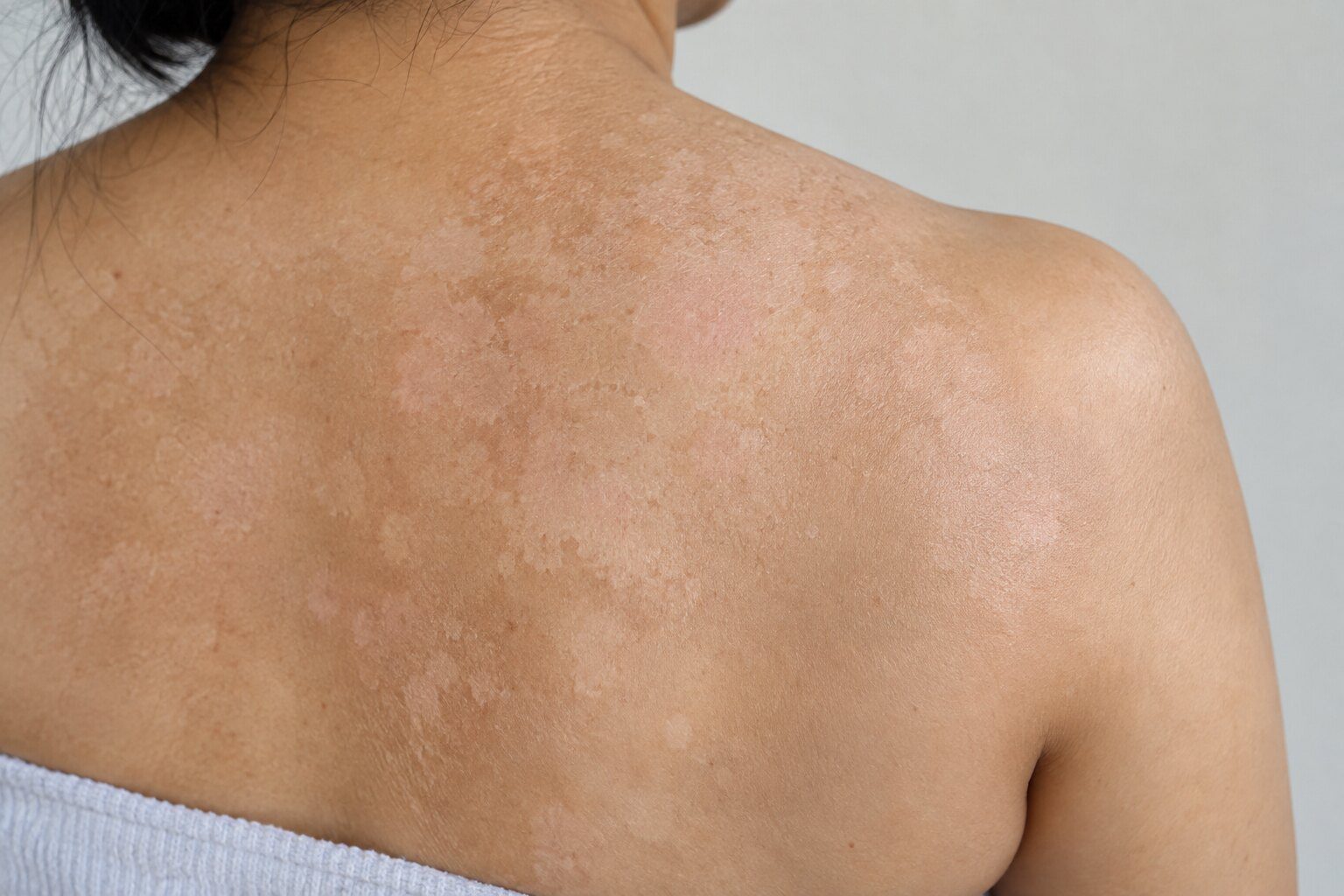
Flat, irregular patches usually affect the chest, back, shoulders, upper arms or neck and may merge. They can be lighter, darker, pink or tan compared with surrounding skin.
Fine scale may be easier to see after gentle scraping or stretching the skin. Most people have little discomfort, although mild itch can occur with heat or sweating.
How does it differ from vitiligo and other patches?
Colour alone can mislead. Distribution, scale, borders and speed of change all matter; this table is a guide, not a diagnosis.
| Possible condition | Typical appearance | Distinguishing clue |
|---|---|---|
| Tinea versicolor | Chest, back, shoulders; pale, dark or pink with fine scale | May recur in warm weather; powdery scale on gentle scraping |
| Vitiligo | Sharply defined milk-white patches | Usually no scale; hair colour may change |
| Post-inflammatory pigment change | Light or dark areas after rash or injury | History of redness, itch, scale or trauma |
| Seborrhoeic dermatitis | Red scale on scalp, brows, nose folds or chest | Often greasy or yellow-white scale |
| Other trunk rashes | Multiple patches or scale on the trunk | Different onset, shape and distribution |
Can tinea versicolor spread to family members?
Tinea versicolor is not generally treated as a directly contagious infection because Malassezia is part of normal skin flora. Similar changes in household members may reflect shared climate and individual susceptibility.
This differs from dermatophyte infections that can spread through skin scales and damp areas; see athlete’s foot symptoms and care.
How does a dermatologist confirm the diagnosis?
Typical cases are often diagnosed by distribution, colour and fine scale. If unclear or not responding as expected, a clinician may use skin scraping microscopy, a Wood lamp or dermoscopy.
Not everyone needs every test. Rapid spread, no scale, sharply defined depigmentation or an unusual site warrants reassessment.
How is tinea versicolor treated?
Treatment depends on extent, site, skin condition, recurrence and health. Localised disease may be assessed for topical antifungal treatment; extensive or recurrent disease may prompt discussion of systemic treatment.
Systemic treatment is not suitable for everyone and requires review of health, pregnancy potential, liver status and interactions. Topical products should also be used as directed rather than increased because colour remains uneven.
If the scalp, eyebrows or nose folds are also red and scaly, read about seborrhoeic dermatitis symptoms and treatment.
Why can pale or dark patches remain after treatment?
After yeast activity is controlled, scale may improve first while pigment recovery takes longer. Tanning can make contrast more obvious and does not prove treatment failure.
Photographs in consistent light can track spread, scale or new patches. Colour alone may be observed with sun protection; persistent scale or new lesions need follow-up.
How can recurrence be reduced?

- Dry the skin, shower and change damp clothes after heavy sweating
- Choose loose, breathable clothing
- Wash and dry towels and clothing regularly without excessive disinfection
- Use gentle cleansing and avoid repeated scrubbing or exfoliation
- Discuss seasonal prevention with a clinician if recurrences are predictable
Dry skin or over-cleansing can also cause scale; see dry and itchy skin care.
When should you see a dermatologist?
- A new widespread pigment change with an uncertain cause
- Rapid spread, no scale or marked colour change
- Pain, significant redness, drainage, pustules or fever
- Scale persists after appropriate care or episodes recur quickly
- Pregnancy, impaired immunity, liver disease or other treatment
- Skin changes cause significant anxiety or affect daily life
Dermatology assessment · More skin health guides
Which dermatology sources support this guide?
- American Academy of Dermatology: Tinea versicolor overview
- American Academy of Dermatology: Diagnosis and treatment
- DermNet: Pityriasis versicolor
- NHS: Pityriasis versicolor
Sweating, heat and humidity can favour yeast overgrowth, but sweat alone is not the cause and it does not mean poor hygiene.
It is not usually considered directly contagious. Household members with a rash should still be assessed separately.
Scale may improve first and colour may take longer. Continuing scale, new lesions or spread needs review.
Tinea versicolor often has fine scale on the trunk; vitiligo is usually sharply defined, milk-white and non-scaly.
Tanning is not a treatment and may increase contrast. Confirm whether the rash is active and use sun protection.
Warm, humid, sweaty conditions favour overgrowth. People with seasonal recurrence can discuss a preventive plan.
Doctor’s note: slow colour recovery does not always mean active infection
Fine scale often settles before skin colour normalises. Do not extend or intensify treatment on your own; persistent scale, spread or recurrence should be reassessed.
This article provides general health education and cannot replace a medical examination. Diagnosis, tests and treatment require individual clinical assessment.
Dermatology medical team

Dr. Tseng