

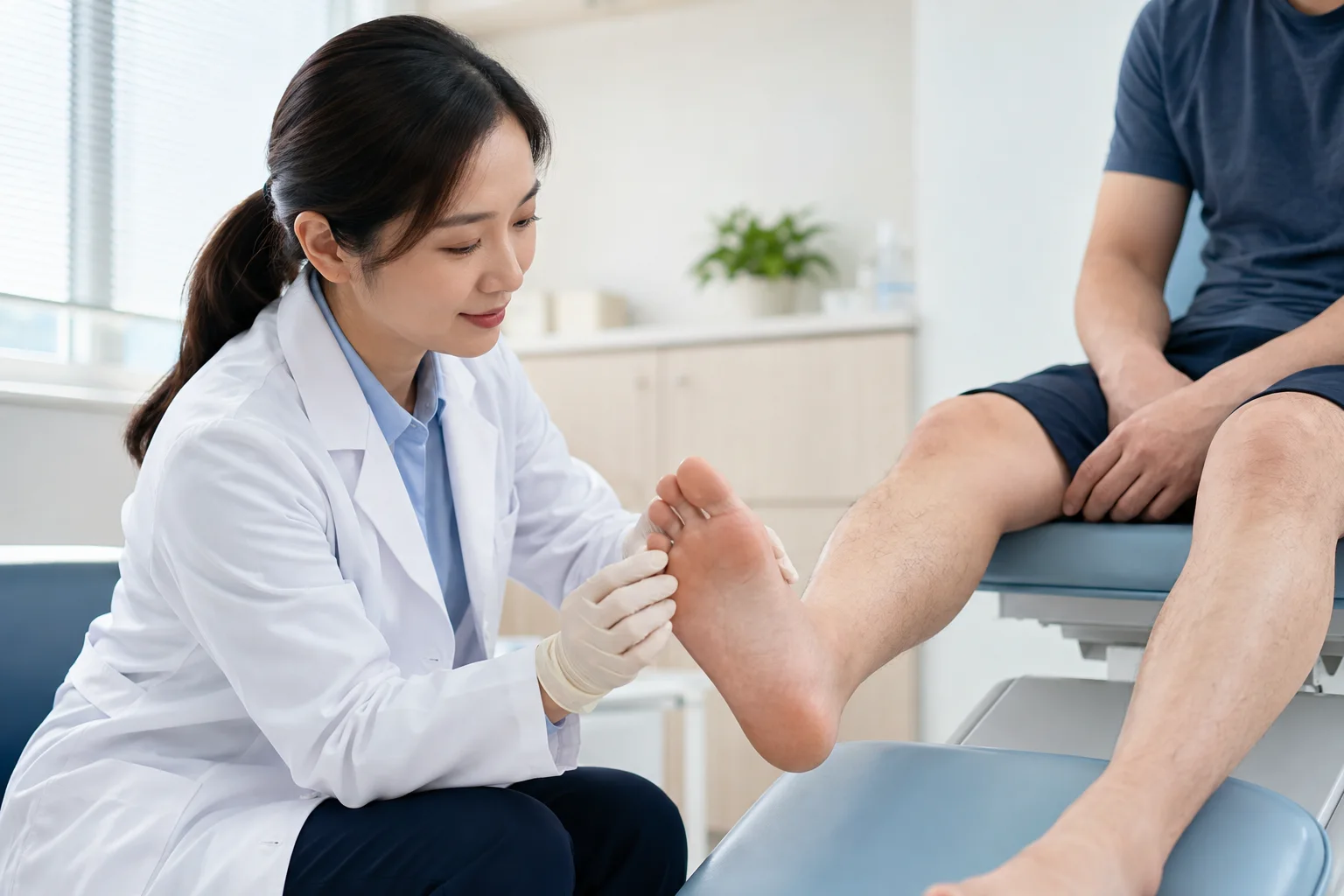
Athlete’s foot, or tinea pedis, is a fungal infection of the outer layer of foot skin. It may cause scaling between the toes, recurring dry or cracked soles, or small blisters along the side of the foot. Eczema, contact dermatitis and psoriasis can look similar.
A photograph or the presence of itch cannot confirm the diagnosis. A clinician considers the distribution, scale, toenails and other skin sites, and may take a small skin scraping for fungal testing before choosing treatment.
Key points: One-sided or uneven scaling between the toes, along the edge of the sole, or with blisters raises suspicion for tinea pedis. Seek dermatology review if repeated self-treatment has not helped, both feet are affected symmetrically, or redness, warmth, pain, swelling or drainage develops.
What is athlete’s foot, and is it contagious?
Tinea pedis is usually caused by dermatophyte fungi. Infected skin scales can spread through direct contact, shared towels or footwear, bathroom floors and communal changing areas. Persistently damp feet, sweaty skin and poorly ventilated shoes create a favourable environment.
A single step on a damp floor does not guarantee infection. Skin barrier health, amount of exposure, humidity, fungal nail disease, diabetes, circulation problems and altered immunity can all affect risk and course.
For recurring scaling or itch, start with Ruianc Clinic dermatology services.
What are the common symptoms and patterns of tinea pedis?
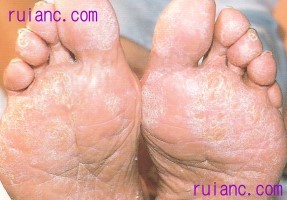
Appearance varies with the affected site and skin response, and more than one pattern can occur at the same time. These are clues rather than a self-diagnosis.
| Common pattern | Typical site and appearance | What can be missed |
|---|---|---|
| Interdigital | Scaling, whitish softened skin, cracks or itch—often between the fourth and fifth toes | Moist skin may smell; broken skin can develop bacterial infection |
| Moccasin pattern | Dry fine scale or thickening over the sole and sides of the foot | It may not itch much and can be mistaken for dry skin |
| Vesicular | Clusters of small itchy or burning blisters on the arch or side of the foot | It can resemble eczema, so distribution and scale matter |
| Ulcerative or acutely inflamed | Erosions, drainage, pustules, pain or swelling | Bacterial infection should be considered rather than treating itch alone |
How is athlete’s foot different from eczema or contact dermatitis?
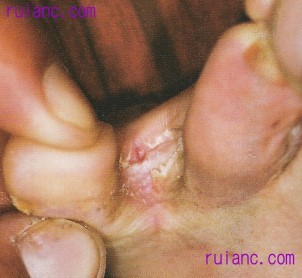
Tinea pedis often begins on one foot or has an uneven distribution, with scale between the toes or around the sole. Eczema and contact dermatitis may be more symmetrical and may follow exposure to shoe materials, cleansers, sweat or friction.
These are tendencies only. Fungal infection and eczema can also coexist.
If dryness and scaling are the main concern, see causes and assessment of dry, itchy skin.
Why avoid prolonged self-treatment with anti-itch or combination products?
A rash that looks less red after itch relief is not proof that fungus is gone. Some products can alter the appearance and make later diagnosis harder; the wrong approach may allow infection to spread or irritate eczema.
When is a skin scraping or fungal test needed?
A typical case may be diagnosed from history and examination. A clinician may scrape a small amount of scale from the active edge for microscopy or culture when the appearance is atypical, treatment response is unexpected, the rash keeps returning, or eczema and psoriasis remain possible.
The toenails, palms, groin and other skin sites may also be examined. Untreated fungal nail or skin infection can be a source of reinfection, while a negative result still needs interpretation in light of sampling site and previous treatment.
How is athlete’s foot treated, and why can it return?
Limited, mild tinea pedis is often managed with topical antifungal treatment. More extensive, thick, recurrent or nail-associated disease, or poor response to topical care, requires a clinician to consider health conditions, interactions and test findings before choosing other options.
Feeling better does not always mean the infection has been fully addressed. Incomplete use, missed toe webs or sole margins, damp footwear, renewed exposure, fungal nail disease or an incorrect original diagnosis can all contribute to recurrence.
Should you pop blisters or file thick skin during treatment?
Do not deliberately pop blisters, cut away softened skin or aggressively file thick skin. These actions can create wounds and increase bacterial infection risk. Wash gently, dry carefully and follow the clinician’s instructions.
How can you reduce recurrence and spread at home?
Along with treating the skin, reduce repeated moisture and re-exposure to fungal scales. Practical steps include:
- Wash the feet daily and pat the spaces between the toes completely dry.
- Change damp socks; rotate shoes and allow them to dry fully.
- Wear sandals in communal showers, changing rooms and around pools.
- Do not share towels, socks, shoes, nail clippers or foot files.
- Wash hands after touching the rash or applying treatment.
- Household members with foot or nail changes should seek their own assessment.
When should athlete’s foot be checked promptly?
Arrange dermatology review if scaling persists, spreads or repeatedly returns after self-care. Seek prompt assessment for the following:
- Rapidly increasing redness, warmth, swelling or pain; pus, foul drainage or fever.
- A crack or wound that does not heal, or significant pain when walking.
- Spread to the toenails, palms, groin or other skin areas.
- Diabetes, poor circulation, altered sensation or impaired immunity.
- Worsening after treatment or repeated episodes without a confirmed diagnosis.
For more skin-health guides, visit Ruianc Clinic Health Library; Individual skin conditions still require an in-person medical assessment.
Which sources support this athlete’s foot guide?
- American Academy of Dermatology: Athlete’s foot prevention
- DermNet: Tinea pedis
- Centers for Disease Control and Prevention: Ringworm prevention
No. Interdigital or blistering disease may itch, but the moccasin pattern can present mainly as dry scale and thick skin.
No. Eczema, contact dermatitis, psoriasis and friction can also peel. Fungal testing may be needed when the pattern is unclear.
Yes, it can. Fungal scales may spread through shared towels, footwear, floors or foot-care tools.
Not necessarily. Incomplete use, damp shoes, re-exposure, fungal nails or a different diagnosis can all cause recurrence.
Keeping feet dry helps reduce recurrence but does not replace an accurate diagnosis and appropriate treatment.
Cracks, wounds, redness, warmth, swelling, drainage or walking pain need prompt medical assessment; avoid cutting or filing the lesion yourself.
Doctor’s note: peeling soles do not always mean athlete’s foot
Tinea pedis, eczema, contact dermatitis and psoriasis can look alike and may coexist. If the rash recurs, spreads, drains, hurts or does not improve with self-care, a dermatologist should examine it and decide whether fungal testing is needed.
This article provides general health education and is not an advertisement or recommendation for a specific medicine. Diagnosis, testing and treatment require an in-person medical assessment.
Dermatology team

Dr. Tseng