

When looking in the mirror, you might notice grain-sized, firm, white bumps appearing under your eyes, on your eyelids, or on your cheeks. They neither hurt nor itch, and they cannot be squeezed out even with force—many people call them “fat granules” or “oil seeds,” assuming they are caused by overly rich eye cream or “internal heat.” In fact, these tiny white spots are mostly milia, and what is trapped inside is not fat, but keratin.
Milia are benign skin changes and are not contagious. Neonatal milia usually resolve on their own, whereas adult milia may persist longer. Picking at them with a needle or forcibly squeezing them yourself can easily lead to redness, swelling, infection, or scarring. If you wish to have them treated, or if you are unsure whether they are milia, an in-person evaluation by a dermatologist is recommended.
Key Takeaways: Milia are tiny cysts formed when keratin becomes trapped beneath the surface layer of the skin. They appear as white or yellowish, grain-sized firm bumps commonly found around the eyes, cheeks, nose, and forehead, and are typically painless and non-itchy. They are neither acne nor fat. Neonatal milia mostly resolve spontaneously; in adults, they may be associated with skin injury, sun exposure, heavy skin care products, or long-term use of topical corticosteroids. Squeezing or pricking them yourself is not recommended. If they affect your appearance or continue to increase in number, a dermatologist can evaluate them and remove them using sterile instruments or discuss other management options. Actual diagnosis and treatment require an in-person evaluation by a dermatologist.
What Are Milia? Why Are They Called “Fat Granules”?
A milium (plural: milia) is a very small superficial cyst. The skin continuously sheds old keratin, and when dead skin cells fail to slough off normally and become trapped in a tiny pocket beneath the epidermis, they gradually accumulate and harden into small white bumps.
Because they look white and round—resembling a tiny droplet of fat or oil—they are colloquially called “fat granules” or “oil seeds” (and commonly known as “milk spots” in infants). However, their contents are actually keratin protein, not fat, and they differ from acne caused by clogged pores. Milia can occur at any age, from newborns to adults.
What Do Milia Look Like? Where Do They Commonly Appear?
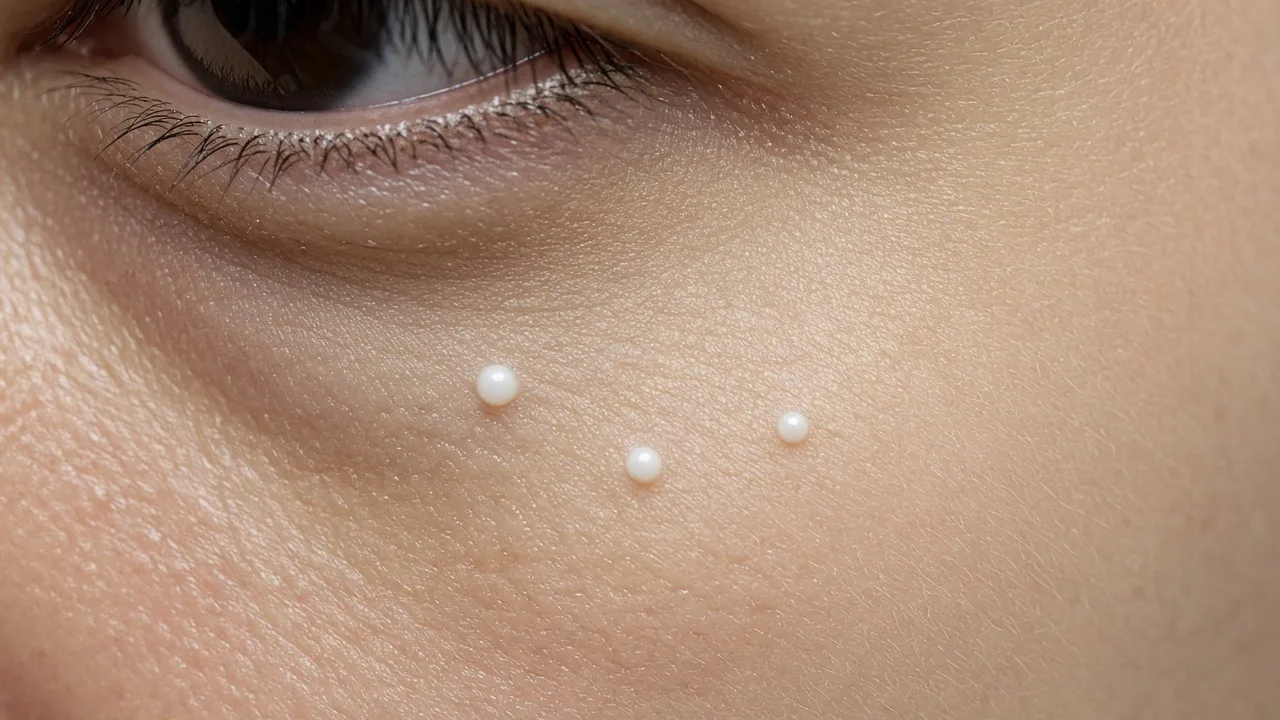
The following characteristics are for general understanding only and cannot replace a physician’s diagnosis:
Appearance
Small, round bumps that are white, pearly white, or pale yellow, roughly the size of a grain of rice or a sesame seed. They have a smooth surface, feel relatively firm to the touch, and the surrounding skin is usually not red. They may appear singly or, frequently, in clusters.
Sensation
Most are painless, non-itchy, and do not suppurate. If irritated by friction from clothing or attempts at self-squeezing, the surrounding area may become temporarily red.
Common Sites
In adults, they commonly appear around the eyes (lower eyelids, upper eyelids), cheeks, nose, and forehead. In newborns, they commonly appear on the nose, cheeks, and chin, and similar tiny white cysts may also appear on the roof of the mouth (palate) or gums. In a small number of people, they may occur behind the ears, on the trunk, or at sites of previous injury or blistering.
Causes and Common Types of Milia
Milia can be broadly divided into two main categories:
Primary Milia
Formed directly from trapped, unexfoliated keratin without an obvious trigger, commonly seen in newborns as well as around the eyes and on the cheeks of adults. Neonatal milia are very common and typically resolve on their own within a few weeks after birth.
Secondary Milia
Developing at sites where the skin has previously been damaged. Possible associated factors include:
- Following the healing of burns, abrasions, or blistering skin conditions
- Skin damage caused by chronic sun exposure
- During the recovery period after certain cosmetic procedures such as laser treatments, chemical peels, or dermabrasion
- Long-term use of topical corticosteroids
- Skin care products or cosmetics with heavy, highly occlusive textures (may be related, though individual variation is large)
Rare Types
In rare instances, milia may cluster together on raised plaques (milia en plaque) or erupt in large numbers over a short period (multiple eruptive milia); there are also forms associated with genetic conditions. These situations are uncommon and require further evaluation by a physician to check for other underlying conditions.
How Do Milia Differ from Whiteheads, Syringomas, and Epidermoid Cysts?
Tiny bumps on the face are not always milia. The following comparison is for reference only; actual diagnosis requires examination by a physician:
Both syringomas and milia frequently occur around the eyes and can easily be confused in appearance, yet their management differs. If small bumps on your face are increasing in number, it is advisable to have a dermatologist confirm their type first. For larger subcutaneous lumps that can become inflamed, please refer to What Is an Epidermoid Cyst? Symptoms, Treatment, and When to See a Doctor; rough, tiny bumps on the upper arms and thighs may be Keratosis Pilaris, which is distinct from milia.
| Feature | Milia | Whiteheads (Closed Comedones) | Syringomas | Epidermoid Cysts |
|---|---|---|---|---|
| Appearance | White or pale yellow, firm, grain-sized | Small white bumps, often accompanied by other acne lesions | Skin-colored or pale yellow, slightly flat small papules | Skin-colored round lumps, varying in size, may have a central dark punctum |
| Common Sites | Around the eyes, cheeks, nose | Oily areas such as the forehead, nose, and chin | Lower eyelids, around the eyes | Face, neck, back, behind the ears |
| Contents | Keratin | Sebum and keratin | Proliferation of sweat gland ducts (no cyst contents) | Keratin, may have an unpleasant odor |
| Inflammation | Rare | May develop into red, swollen acne | Rare | May become inflamed, red, swollen, and painful |
| Can It Be Squeezed Out Yourself? | Usually cannot be squeezed out | Squeezing not recommended | Cannot be squeezed out | Squeezing not recommended |
Can You Squeeze Milia Yourself?
It is not recommended. The surface of a milium is covered by an intact layer of epidermis that encloses its contents, so squeezing with your fingers usually will not expel it. Repeated forceful squeezing may instead:
- Cause skin redness, swelling, and broken skin, or even lead to bacterial infection
- Leave post-inflammatory hyperpigmentation or depressed scars, especially around the eyes where the skin is thin and sensitive
- Trigger additional secondary milia following skin injury
Online tips suggesting that “you just need to prick it with a needle” are risky at home because it is difficult to ensure sterile instruments, proper depth, and angle, and other skin conditions may be mistaken for milia. If you want them removed, we recommend having a dermatologist evaluate them.
How Do Dermatologists Evaluate and Treat Milia?
Evaluation
Physicians can diagnose most milia through visual inspection, using dermoscopy when necessary. If the appearance is atypical, or if lesions erupt rapidly in large numbers or cluster on plaques, the physician may arrange further examinations to determine whether they are associated with other conditions.
Management Options
Milia are benign skin changes and do not necessarily require treatment. Neonatal milia usually only need observation. If adults are bothered by their appearance, they may discuss the following options with a physician:
- Removal with sterile instruments: The physician uses a sterile needle or fine blade to make a tiny opening on the surface and extract the contents; this is a common approach.
- Cryotherapy, electrocautery, or laser treatment: Depending on the number of lesions, location, and skin condition, a physician will evaluate whether these modalities are suitable.
- Topical medications: When lesions are numerous, the physician may evaluate the use of topical retinoids or other medications that promote keratin turnover; suitability and instructions for use must follow the physician’s guidance.
- Special types: For rare forms such as milia en plaque, the physician may separately evaluate oral antibiotics or other medications and treatments.
New milia may still appear after treatment. The required method and number of sessions vary from person to person and must be evaluated by a physician according to each individual’s condition.
How to Care for Your Skin Daily? 6 Key Tips to Reduce Milia

1. Gentle cleansing: Wash your face daily with a mild cleanser, avoiding vigorous rubbing or frequent use of gritty scrubs.
2. Review skin care product textures: If milia repeatedly appear around your eyes, check whether you are using heavy, highly occlusive products, and discuss adjustments with your physician.
3. Practice sun protection: Skin damage from sun exposure may contribute to milia; remember to use shade and sunscreen when outdoors.
4. Do not squeeze or prick them yourself: Avoid injuring the skin and reduce the chance of developing secondary milia.
5. Use topical corticosteroids as prescribed: Do not apply them long-term on your own; consult your physician regarding any medication questions.
6. Infant milia require no special treatment: Simply wash the baby’s face with plain water or a mild infant cleanser and pat dry gently; do not squeeze the bumps or apply adult skin care products.
Common Myths About Milia
Are “fat granules” caused by eye creams being too rich or oily?
Not necessarily. Heavy skin care products may be one contributing factor, but milia are also frequently related to keratin turnover, sun exposure, and skin injury. Some people develop milia even without using eye cream.
Are milia caused by “internal heat” or poor health?
There is currently no evidence showing that milia are related to “internal heat.” Most milia are simply benign skin changes.
Are milia a type of acne?
No. Acne is associated with clogged pores, sebum, and inflammation, whereas milia are tiny cysts formed by trapped keratin, and they are managed differently.
Should white spots on a newborn’s face be squeezed out or treated with ointment?
No. Neonatal milia mostly resolve on their own within a few weeks. Avoid squeezing them or applying adult products; if they are accompanied by a red rash, peeling, or fail to resolve over time, have a physician evaluate them.
When Should You See a Dermatologist?
An in-person evaluation by a dermatologist is recommended if any of the following occur:
- Milia affect your appearance and you want them safely removed
- The number of bumps increases noticeably within a short period, or they cluster together on raised plaques
- They appear at sites of previous burns, blisters, or other skin diseases
- The bumps become red, swollen, painful, or pus-filled, or become inflamed after self-squeezing
- You are unsure whether the lesions are milia, syringomas, epidermoid cysts, or another condition
- White spots on an infant persist for several months without fading, or are accompanied by other skin or systemic abnormalities
To learn more about skin concerns managed at our clinic, please visit Dermatology; for more health information, please see our Health Education section.
Health Education References
Neonatal milia mostly resolve spontaneously within a few weeks. In adults, some milia gradually disappear over time, while others persist longer. If they affect your appearance, you may consult a dermatologist for an evaluation of management options.
No. Milia are tiny cysts formed by keratin, not an infection, and cannot be transmitted through contact.
It is possible. An individual milium that has been removed usually does not recur at the exact same spot, but factors such as skin predisposition, skin care habits, sun exposure, or skin injury may still lead to new milia forming elsewhere.
Gentle skin care that supports keratin turnover may help reduce the formation of new milia, but its effect on existing bumps varies from person to person. Over-exfoliation can irritate the skin instead. Because the skin around the eyes is thin, consulting a physician before use is recommended.
Not necessarily. They could also be syringomas, xanthelasma, or other skin changes, each requiring different management. An examination by a dermatologist is recommended for confirmation.
In most cases, no. Keeping the skin clean and avoiding squeezing is sufficient; however, if the bumps are numerous, persist without fading, or are accompanied by other abnormalities, medical evaluation is recommended.
Physician’s Reminder: Milia Are Mostly Benign—Leave Removal to a Doctor and Do Not Squeeze Them Yourself
Milia are tiny cysts formed by keratin, not fat or acne. Squeezing them yourself or picking at them with a needle can easily cause inflammation, hyperpigmentation, or scarring. During your consultation, you can share when they appeared, their locations, changes in number, the skin care products and topical medications you use, and whether you have had prior skin injuries or procedures so the physician can examine and assess your condition. Whether removal is needed and which method to use must be evaluated in person by a qualified physician.
This article is health education information, not a drug advertisement, and does not recommend or sell any specific medicine. It cannot replace a medical examination; diagnosis, tests and treatment should be assessed in person by a doctor based on each individual situation.
Dermatology doctor team

Dr. Tseng