


Seeing hair on the pillow is often a follicle finishing one growth cycle, not proof that the follicle has failed. Neighbouring follicles sit in different phases, so some hairs are lengthening, some are changing, and some are ready to leave.
The useful question is not a one-day count used as a diagnostic line. It is how the cycle works, when it may be interrupted, and which density, distribution and scalp changes need a clinician.
Key points: Most scalp follicles spend most of their time in anagen. Only a smaller share enter catagen and telogen before shedding, so daily hair on a comb can still be part of the cycle. A sudden overall increase, thinning in a fixed area, a round bald patch, or redness, itch or pain should not be dismissed as normal turnover and needs an in-person dermatology assessment.
What phases make up the hair growth cycle?
Scalp follicles do not grow in lockstep. One hair usually moves through anagen, catagen and telogen, then the same follicle grows the next hair. Site, age, nutrition and hormones change how long each phase lasts. The times below are common ranges, not a personal timetable.
Anagen: the hair is lengthening
Terminal scalp hair often stays in anagen for about 2 to 6 years, and most follicles sit in this phase at any one time. A longer anagen gives more chance for length. Eyebrows, lashes and body hair have a shorter anagen, so they stay shorter.
Catagen: growth pauses and the follicle shrinks
Catagen usually lasts about 2 to 3 weeks. Cell division slows, the link with the dermal papilla weakens, and the hair moves toward the surface. It does not always fall out at once.
Telogen: growth stops, then the hair leaves
Telogen often lasts about 2 to 3 months. The hair has stopped growing and sits more loosely, so combing, washing or a new hair pushing it out makes shedding easier to see. Some texts name a separate exogen phase for actual release; clinics often still describe it with telogen.
Why can daily shedding still be ordinary?
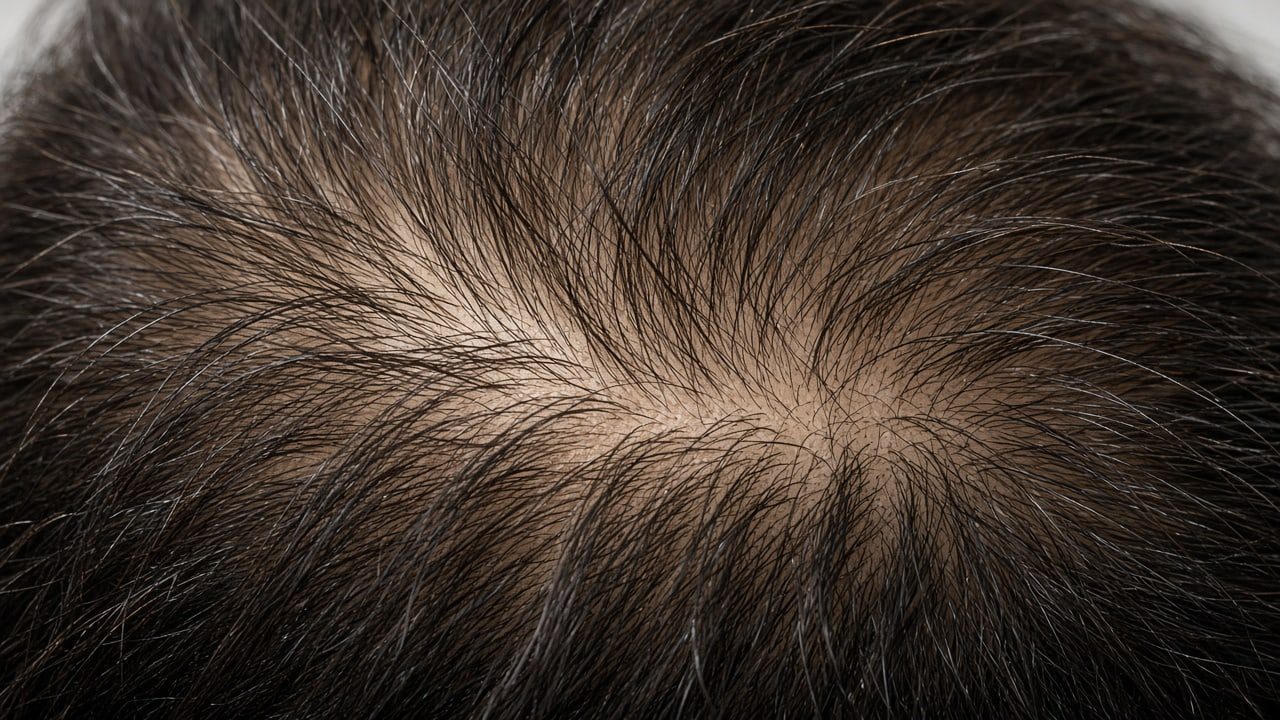
Because follicles are out of step, a few hairs finish telogen every day. Hair on a pillow, comb or floor does not by itself prove balding.
How much you see on one day also changes with wash interval, length and how you comb. After a longer gap, with longer hair, or if you rarely detangle, the same collection looks heavier.
A one-day count is not a diagnostic line. For counts, density change and warning signs, see how to judge daily shedding amount. If a wash looks heavy, compare shedding versus breakage in the shower.
What does shedding look like when the cycle is interrupted?
An interrupted cycle is not only “more hair on the comb”. More follicles may enter telogen early. Anagen may shorten and hairs may grow finer. A patch of follicles may stop growing suddenly.
That is why “I have been tired” or “it is that season” cannot explain every pattern. Distribution, speed and scalp symptoms often tell more than a one-day count.
| Possible pattern | Common cycle change | Visible clues | Next step |
|---|---|---|---|
| Physiological turnover | A small share of follicles leave after telogen | Overall volume stays fairly steady; daily amount varies with washing and combing | Watch density under fixed conditions; no need to count every day |
| Telogen shedding | More follicles enter telogen earlier | Overall shedding rises months later, usually without a sharp bald patch | Review triggers and follow the trend; seek care if thinning continues |
| Pattern hair loss | Anagen shortens and follicles miniaturise | Hairline, crown or part thins slowly; finer hairs increase | A clinician checks distribution and shaft calibre |
| Alopecia areata | Local follicles stop growing suddenly | A round or fairly well-edged bald area appears quickly | Arrange a dermatology assessment early |
| Scarring hair loss | Follicle structure is damaged and no longer cycles normally | A smooth patch, fewer follicle openings, possible pain or inflammation | Assess early; do not only wait for the cycle to recover |
Which cycle clues can you watch at home?
Home observation is for a timeline and a map, not a self-diagnosis. Density under fixed conditions is more useful than counting hairs every day.
- Use the same light, angle and hairstyle to photograph the front, crown, sides and back every few weeks.
- Note whether shedding is overall, or clearer at the temples, crown, part or one small patch.
- Watch whether the same area shows more fine short hairs, or more broken fragments.
- Count back a few months for illness, surgery, postpartum change, rapid weight loss, poor intake or major stress.
- Tell the clinician about redness, itch, pain, thick scale, pustules or crust.
If the past few months brought stress, sleep change or a body event, also see the time lag of stress-related telogen shedding.
Which hair-loss patterns should not be explained by the cycle alone?
The cycle can explain why some hair leaves every day. It cannot explain every drop in density. Treating pattern hair loss, alopecia areata or scalp disease as ordinary turnover can delay assessment.
If temples recede, the crown thins or shafts grow finer, compare early signs and stages of male-pattern hair loss. To tell temporary rest, gradual miniaturisation or scarring damage apart, see whether shedding means the follicle is already damaged.
- Shedding lasts for months, density clearly falls, or scalp visibility keeps increasing.
- The hairline recedes, the crown thins, or a part keeps widening.
- A round, patchy or left-right uneven bald area appears suddenly.
- The scalp is red, itchy, painful, thickly scaled, pustular, wet or crusted.
- There is also fatigue, a clear weight change, feeling cold, palpitations, menstrual change or other body symptoms.
How does a clinic assess the follicle cycle?

A clinician first asks when shedding started, whether it is diffuse or local, and whether the past few months included illness, surgery, postpartum change, weight loss, diet change or stress, then examines the scalp, shaft calibre, follicle openings and distribution.
Trichoscopy can show density, calibre mix, new growth, breakage and follicle openings, and help separate telogen shedding, pattern hair loss, alopecia areata and inflammatory disease. A pull test, blood tests or biopsy are not needed for every person; they follow the clues.
Treatment depends on the diagnosis; one hair product cannot cover every cycle change. For further assessment, start with Ruianc Clinic hair-loss assessment. Related clinic articles are also in the Ruianc Health Library.
Which hair-cycle sources does this article use?
- DermNet: Hair shedding
- American Academy of Dermatology: Hair loss or excessive hair shedding
- British Association of Dermatologists: Telogen effluvium
A scalp follicle usually moves through anagen, catagen and telogen, then grows another hair. Phase length varies with site, age and health. A single timetable cannot be applied to everyone and needs an in-person medical assessment.
In ordinary turnover and many telogen-shedding patterns, the hair leaves and the follicle can remain and start another cycle. A smooth patch, fewer openings, or pain and inflammation needs scarring causes to be excluded. Do not assume the hair will return on its own.
Daily hairs on a comb can be part of an out-of-step cycle and do not by themselves mean balding. Density, distribution and scalp symptoms over weeks to months are more informative. Ongoing thinning or a fixed sparse area still needs a dermatologist.
Telogen shedding often has a delay of about 2 to 4 months after a trigger. Review the previous months of illness, surgery, postpartum change, weight loss, diet and stress, not only a few late nights. Timing varies between people.
Either is possible. After telogen shedding you may see short hairs close to the original calibre. Pattern hair loss may add more fine, soft hairs in the same area. Length alone cannot separate them; distribution and trichoscopy are needed together.
Start with dermatology or a hair-loss clinic. A clinician uses the timeline, distribution, shaft calibre and scalp findings to separate ordinary turnover, telogen shedding, pattern hair loss, alopecia areata and scalp disease, then decides whether blood tests or other checks are needed.
Doctor’s note: look first at whether the cycle is interrupted, not only at today’s count
Hair normally cycles through anagen, catagen and telogen, and a one-day amount moves with washing and combing. Clinic assessment pays more attention to density, distribution, shaft calibre, and illness, stress, weight change or other body events in the past few months. A sudden overall increase, thinning in a fixed area, a round patch or scalp inflammation should not be called ordinary cycling on its own.
This article provides general health education and is not an advertisement or recommendation for a specific medicine. Diagnosis, testing and treatment require an in-person medical assessment.
Hair-loss medical team

Dr. Tseng