

When you comb or wash your hair in the morning, or someone points out that there is a patch missing on your head, many people first wonder whether it is too much stress, or the condition commonly called “gui ti tou” in Chinese. What usually follows is a string of worries: will the patch keep getting larger, can it spread to family members, and should you start applying something right away.
A sudden bald patch on the scalp can have more than one cause. For some people it really is alopecia areata (commonly called “gui ti tou” in Chinese). For others it is actually tinea capitis, and for others it is a bald area left by repeated pulling or plucking of the hair. The appearance can sometimes look very similar. Looking in a mirror or comparing photos is not a reliable way to confirm the diagnosis yourself. Working out what it is, and when to see a dermatologist, is more useful than buying a hair-growth product first.
Key points: Alopecia areata is a non-scarring form of hair loss that happens when the immune system mistakenly attacks hair follicles. The follicles are usually not destroyed, so the hair has a chance to grow back, but there is no guarantee that it will, or that it will not fall out again. It is not contagious, and it is not as simple as “just too much stress.” Patches are common on the scalp and may also affect the eyebrows, eyelashes, beard, or other hair-bearing areas. Short, fine broken hairs are sometimes visible at the edges, and some people develop small pits in their nails. What looks like alopecia areata may also be tinea capitis, traction, hair pulling, or scarring hair loss, and a physician needs to tell these apart. There is currently no method that can guarantee a cure or guarantee that the condition will not come back, but a physician can discuss watchful waiting, topical or local anti-inflammatory treatment, contact immunotherapy, or systemic immunomodulatory medicines such as JAK inhibitors, depending on the extent, the course, and the person’s age.
If a bald patch appears suddenly on the scalp, is it alopecia areata?
Not necessarily, but alopecia areata is one of the common causes. It refers to hair that falls out suddenly in patches. The scalp surface usually looks smooth, without obvious scarring. There may be one patch or several. The shape is often a fairly clear circle or oval. Sometimes the patches join into a larger area. In a minority of people, hair is lost from almost the entire scalp, or the eyebrows, eyelashes, and body hair are affected as well. There is also a pattern in which a band of hair loss appears at the back of the head (the occipital area). It does not only start on the scalp; the beard or other hair-bearing areas may be affected first.
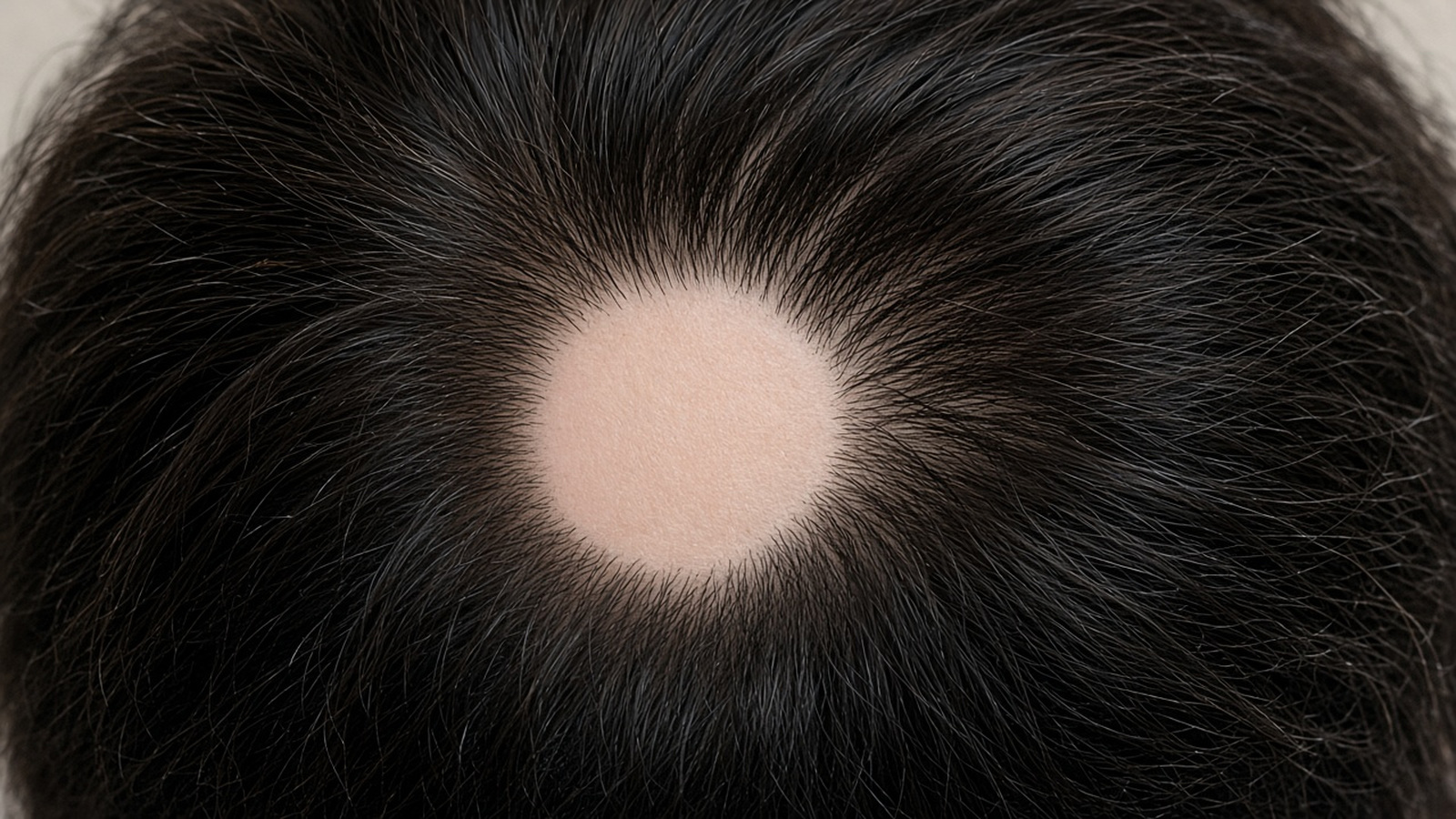
At the edge of a bald area, short, fine broken hairs with a thinner root are sometimes seen. Some people call these “exclamation mark hairs.” A few people feel a little itching, stinging, or burning there before a new patch appears, but these sensations are not a reliable basis for judging the condition yourself. Some people develop small pits in their nails; others notice brittleness, lengthwise ridges, or a rougher nail surface. This does not mean everyone will have these changes.
Alopecia areata itself is not contagious. If the scalp is also red, itchy, scaly, pustular, or tender, infection or another type of hair loss should be considered first. You should not decide on your own that it is “gui ti tou” just because a patch appeared suddenly.
Children can also develop localized hair loss. The American Academy of Dermatology notes that alopecia areata is a fairly common type of hair loss in children, but missing hair on a child’s scalp may also be tinea capitis, traction, or hair pulling, and a physician still needs to tell these apart. If a child in the family has this kind of change, you may also refer to What to do about hair loss in children.
Why does it happen? Is it only too much stress?
Alopecia areata is currently understood as an autoimmune condition: the immune system mistakenly treats growing hair follicles as something to be cleared away, and the hair falls out suddenly. The follicles are usually not destroyed, so there is still a chance that hair will grow again later. There is no single answer for why this attack starts; both genetic and environmental factors may be involved.
It sometimes appears more often in a family, but “someone in the family has alopecia areata” does not mean that children will definitely get it. A patient information leaflet from the British Association of Dermatologists notes that about 2 in every 10 people with alopecia areata can report a family history. Even when there is a family tendency, other factors are still needed before it may appear.
Psychological or physical stress, and a previous infection, are sometimes mentioned as possible triggers. These are possible triggers, not a clear cause that everyone can identify, and they should not be used to blame yourself. Alopecia areata can also occur when there is no obvious stress. Attributing everything to emotions can make it easier to overlook whether the area is still expanding, whether there are other immune-related conditions, or whether it is actually a different type of hair loss. The British Association of Dermatologists also notes that there is currently no evidence that alopecia areata is related to a particular diet.
People with alopecia areata may more often also have other autoimmune or allergy-related conditions, such as thyroid disease, vitiligo, type 1 diabetes, or atopic dermatitis, allergic rhinitis, or asthma. This does not mean that everyone will have each of these. It does mean that other health conditions are worth mentioning at the visit. If pale or white patches also appear suddenly on the skin, you may refer to Are those white patches vitiligo?.
How is it distinguished from tinea capitis, hair pulling, and male pattern hair loss?
Localized hair loss can look similar. A physician judges it by taking together the shape of the bald area, the scalp surface, the pattern of broken hairs, and how quickly it is progressing. The table below is only a guide before you seek care; it cannot replace an in-person examination.
| Possible type | Common appearance | Scalp and hair clues | Suggested next step |
|---|---|---|---|
| Alopecia areata | A round or oval bald patch that appears suddenly | The surface is usually relatively smooth; follicle openings are usually still present; short, fine broken hairs may be seen at the edges | A dermatologist examines the extent and how active it is |
| Infection such as tinea capitis | Localized hair loss or broken hairs | May be red, itchy, scaly, pustular, or tender | Scale or hair testing may be done depending on the situation; see What is tinea capitis? |
| Traction or hair pulling | The shape is often more irregular; long and short hairs are mixed | Broken hairs of uneven length; may be related to tight hairstyles or repeated pulling | Clarify daily habits; see traction alopecia and trichotillomania |
| Male pattern hair loss | A receding hairline or gradual thinning at the crown | Usually progresses slowly, not as a sudden bald patch | Assess the pattern and family history; see Is male hair loss male pattern baldness? |
| Scarring hair loss | Localized thinning or baldness | May be red, painful, or scaly, with fewer follicle openings | Better to seek care early; see Warning signs of scarring hair loss |
If the hair loss is not in patches, but the part is getting wider and the hair is slowly thinning, the type may be different. You may also look at What kinds of hair loss do women get?, and have a physician confirm it.
How does a dermatologist examine it?
A physician will usually first ask when it started, whether it is expanding quickly, whether there have been similar episodes before, whether anyone in the family has hair loss or an autoimmune disease, and whether there has been a recent illness or new medicine. Next they will look at the scalp, eyebrows, and eyelashes, and if needed other hair-bearing areas of the body, and they often look at the nails as well.
Trichoscopy (an instrument that magnifies the view) can be used to look at follicle openings, broken hairs, and the edges of the bald area, and to help judge whether the condition is still active or is actually a different type of hair loss. Not every person with alopecia areata needs a blood test. If the history or physical symptoms raise the possibility of a thyroid problem, iron deficiency, or another issue, the physician will arrange tests according to the individual situation. A small skin sample may be taken only when the appearance is atypical, scarring hair loss is suspected, or the diagnosis is still uncertain. These steps are to confirm the diagnosis and to see whether anything else needs attention; not everyone needs every test.
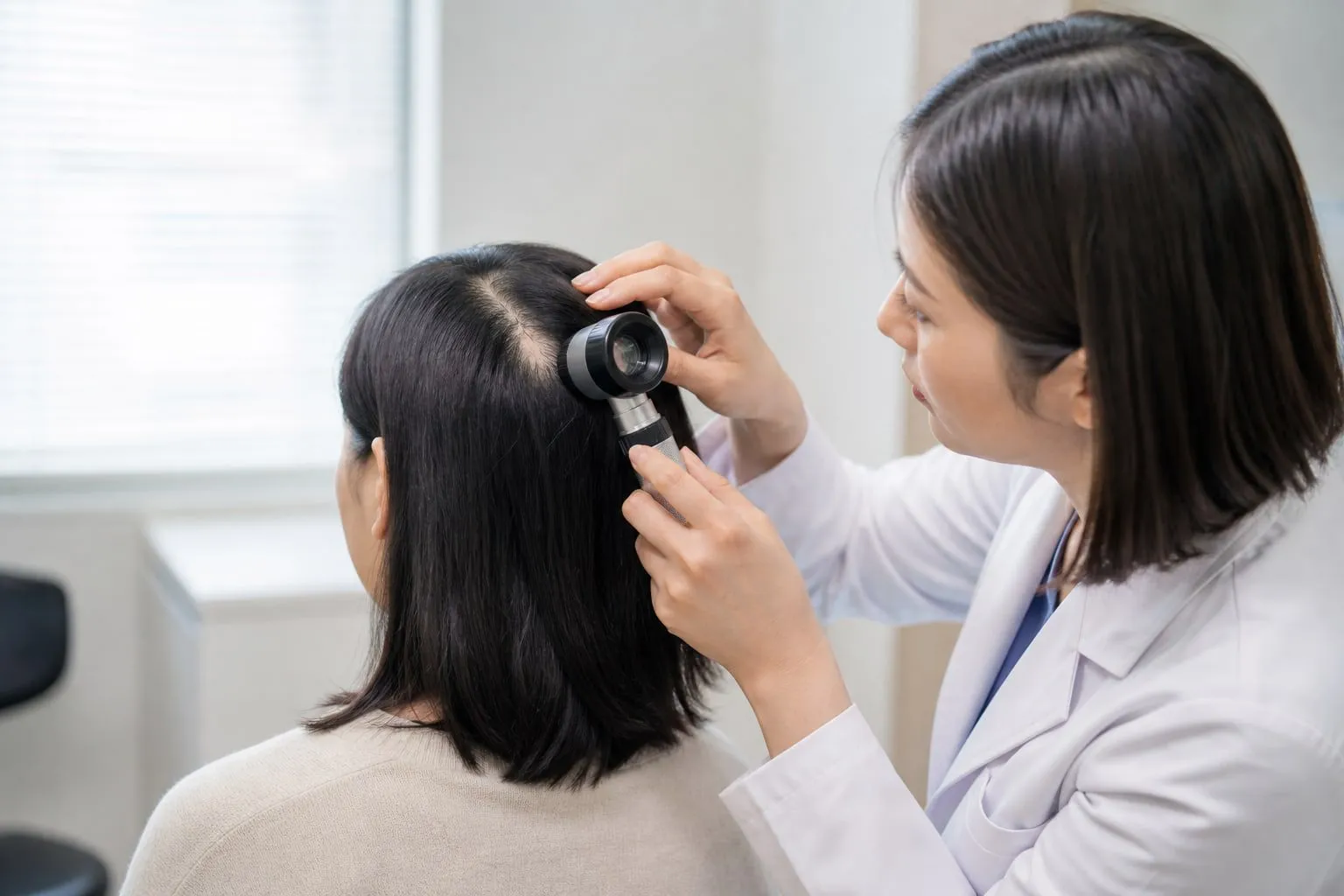
The hair loss and scalp clinic decides which tests to do based on the pattern of hair loss, trichoscopy, and the history. It is not recommended to arrange a full set of untargeted tests on your own first.
What can you do day to day, and what should you expect from treatment?

Start by protecting the scalp that is already exposed. Where there is less hair, that area burns more easily in the sun. When you go out, a wide-brimmed hat, a headscarf, or a wig can provide shade; use sun protection on any area clothing does not cover. If the eyebrows or eyelashes are also affected, a hat or glasses can reduce dust and light reaching the eye area directly. In cold weather, a hat and scarf can also make the scalp more comfortable.
Be gentle when you care for the hair: use a softer comb, avoid forceful pulling or tight hairstyles, and do not irritate the bald area with essential oils, ginger juice, chili, or “hair-growth tonics” of unclear origin. If you want the appearance to look a little closer to what it was, you can use a wig, a hairpiece, a hat, or an eyebrow pencil or false eyelashes. This is a personal choice, not a requirement. Some people consider eyebrow tattooing; it is best to discuss this with a physician first. Taking photographs at intervals, with consistent lighting and angle, to record the extent is more practical than checking in the mirror over and over every day.
Long-term, very strict avoidance of sunlight, or a clear effect on your mood, are both worth mentioning at follow-up visits. Alopecia areata itself is usually not a physical disability, but it is quite common for the change in appearance to cause anxiety or distress. A physician can discuss ways of getting support, and can refer you for appropriate help if needed. A balanced diet is enough; there is no need to start large amounts of supplements on your own because of anxiety.
As for treatment, there is currently no method that can guarantee complete regrowth of the hair, or that it will not fall out again later. Not everyone needs to start active treatment right away. When the area is not large and is relatively stable, especially in children, a physician will sometimes observe first. A patient information leaflet from the British Association of Dermatologists notes that when hair loss already covers more than half of the scalp at the start, the chance of complete spontaneous regrowth is lower. This is a general observation and must not be used to predict any individual’s result. Depending on age, site, and progression, some people discuss topical corticosteroids, locally injected anti-inflammatory treatment, contact immunotherapy, or systemic immunomodulatory medicines such as JAK inhibitors. Different approaches suit different extents and ages, and infection risk, past medical history, and other medicines also need to be assessed first. Follow-up is still needed during treatment. Even if there is improvement, things may change again after treatment is stopped. Whether to treat, and which approach to use, should be explained in person by a physician. Do not buy products of unclear origin on your own, and do not adjust a prescription yourself based on advice from the internet.
When should you see a dermatologist?
It is advisable to see a dermatologist sooner rather than later if any of the following occur: a bald patch clearly expands over days to weeks; several areas appear at the same time; the eyebrows or eyelashes also start to fall; almost the entire scalp is affected; or there are obvious nail changes. Localized hair loss in a child should likewise be checked first to confirm whether it is alopecia areata, infection, or traction.
If the scalp is red and swollen, scaly, pustular, painful, or weeping, or if follicle openings are barely visible in the bald area, infection and scarring hair loss need to be ruled out. If there is also marked fatigue, a change in weight, intolerance of cold, or palpitations, mention this during the visit. Alopecia areata itself is usually not an emergency, but the earlier the cause is clarified, the clearer the basis for whether to treat and how to protect the scalp.
Health Education References
- American Academy of Dermatology: alopecia areata overview
- American Academy of Dermatology: symptoms of alopecia areata
- American Academy of Dermatology: diagnosis and treatment of alopecia areata
- American Academy of Dermatology: self-care for alopecia areata
- National Institute of Arthritis and Musculoskeletal and Skin Diseases: alopecia areata
- National Institute of Arthritis and Musculoskeletal and Skin Diseases: diagnosis, treatment, and steps to take for alopecia areata
- British Association of Dermatologists: alopecia areata patient information leaflet (updated April 2024)
- NHS: hair loss (reviewed 24 January 2024)
Common questions about alopecia areata
Are alopecia areata and “gui ti tou” the same condition?
Yes. “Gui ti tou” is a common Chinese name for alopecia areata. It often appears as sudden, fairly well-defined, round or oval patches of non-scarring hair loss. The name can sound alarming, but the condition is not contagious, and it does not mean the hair follicles have already died.
Is alopecia areata caused by stress? Is it contagious or inherited?
Stress may be a trigger or aggravating factor for some people, but alopecia areata is mainly related to the immune system mistakenly attacking hair follicles. It cannot be attributed to stress alone, and it is not a contagious disease. If someone in the family has alopecia areata, an individual’s chance of developing it may be higher, but that does not mean relatives or children will definitely get it, and there is no need to change how you live together because of it.
Is a blood test always needed for alopecia areata? Can you be sure by looking yourself?
You cannot always tell by looking yourself, and not every patient needs a blood test. A physician will go by the history and an examination of the scalp and nails, and may use trichoscopy if needed. A blood test may be arranged when a thyroid problem, iron deficiency, or another issue is suspected. In a minority of cases, a small skin sample is taken when the appearance is atypical or scarring hair loss is suspected.
Can hair in alopecia areata grow back on its own? If it grows back, can it fall out again?
There is a chance it will grow back on its own, especially when the area is smaller, but this cannot be guaranteed. Newly grown hair is sometimes lighter in color and may later come closer to its original shade. Some people have only one episode; others have repeated patches in different places, or hair grows in one area while it falls out somewhere else. The course is hard to predict from the first appearance alone and still needs to be followed according to what actually happens.
Can you apply a hair-growth product yourself before seeing a physician?
It is not recommended to treat it yourself before the diagnosis is confirmed. Alopecia areata, tinea capitis, traction, and scarring hair loss are managed in different ways. Irritating products or products of unclear origin can make the scalp harder to assess and cannot guarantee that the hair will grow back. Whether a prescription is needed, and which one, should be discussed with a dermatologist.
This article is health information about a medical condition. It does not replace an in-person consultation. Whether the condition is alopecia areata, and whether treatment or a change in care is needed, must be assessed in person by a qualified physician.
Dr. Tseng's reminder: If a bald patch appears suddenly, first confirm whether it is alopecia areata.
A round patch of hair loss is not always alopecia areata. Tinea capitis, traction or hair pulling, and scarring hair loss can also cause localized missing hair. Examining the scalp, follicle openings, and the edges of the bald area first, then arranging follow-up according to the extent and course, is safer than trying unproven remedies on your own.
Hair loss clinic physicians

Dr. Tseng