

A small, rough, hard bump appears on a finger or the sole of your foot. It does not hurt or itch, but over time more appear, and even family members start to get them. This is very likely a viral wart. Viral warts are benign growths caused by human papillomavirus (HPV) infecting the top layer of the skin, and they are especially common in children, teenagers and people who often walk barefoot in shared showers or pool areas.
Viral warts are easily confused with corns and calluses. Cutting or digging them out yourself, or using medicated plasters at random, can spread the virus to surrounding skin or cause a wound infection. Treatment depends on location, size, number and personal circumstances, and most cases need patience and follow-up visits.
Key points: Viral warts are benign skin growths caused by human papillomavirus entering through tiny breaks in the skin. They are common on the fingers, soles and face, look rough and often show tiny black dots, and can spread through contact or picking and increase in number. They are easily confused with corns and calluses. Some warts fade on their own, but treatment often needs several visits and warts may come back. Pain, rapid change, bleeding, or warts on the face or genitals should be assessed in person by a doctor.
What are viral warts and why do they appear?
Viral warts form when human papillomavirus enters the epidermis through tiny breaks in the skin that are hard to see, stimulating skin cells to overgrow into a rough, raised or pressed-in hard bump. They are benign skin lesions.
There are many types of human papillomavirus. The types that cause common warts on the hands and feet are usually different from those linked to genital warts or cervical changes, so there is no need to panic about warts on the hands or feet.
It can take several weeks to several months from contact with the virus until a wart appears, so it is often hard to remember where it was caught. The virus infects more easily when the skin has small cuts, stays damp for long periods or immunity is weaker.
Are viral warts contagious and who is more likely to get them?
Viral warts are contagious, although usually not highly so. The main routes are direct contact with a wart, sharing towels, nail clippers or slippers, and walking barefoot on damp floors such as shared showers and pool surrounds.
Warts can also spread on your own body by self-inoculation, for example by repeatedly picking a wart, biting warts around the nails, or shaving over a lesion, which carries the virus along small cuts to nearby skin. The following groups or situations are more prone to warts:
- Children and teenagers, and people who often go barefoot at school or in sports facilities.
- People who bite their nails, pick at hangnails or often have small cuts on the skin.
- People whose hands or feet are often damp or sweaty, or whose work involves long periods in water.
- People with a weaker skin barrier, such as atopic dermatitis, who scratch the skin easily.
- People with weaker immunity, such as after organ transplant or on long-term immunosuppressive medicines.
If you tend to have dry, flaky skin and keep scratching, see symptoms and care of atopic dermatitis and look after the skin barrier first to reduce broken skin.
What types of viral warts are there and what do they look like?
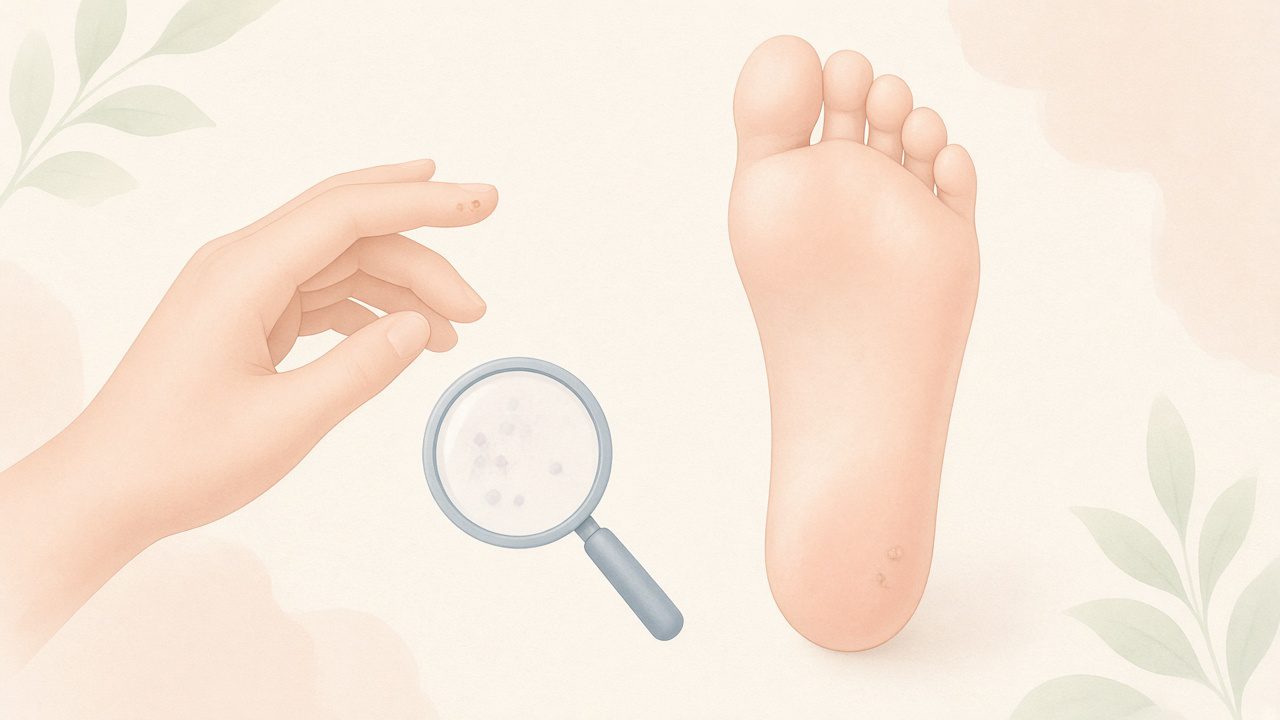
Viral warts look different depending on their location and the virus type. The common types are below, but judging by appearance alone can still be mistaken, so a doctor’s assessment is needed.
Common warts: often on fingers and the backs of hands
Rough, greyish-white or skin-coloured raised bumps that look like tiny cauliflowers, often on the fingers, backs of the hands and around the nails. Looking closely, you may see black or reddish-brown dots, which are clotted tiny blood vessels inside the lesion.
Plantar warts: painful when walking
Found on the soles or toes, they grow inwards under body-weight pressure and are often covered by thick hard skin, so they are easily mistaken for corns or calluses. The skin lines are interrupted over the lesion, walking may cause a stabbing pain, and they sometimes cluster into a patch.
Flat warts: small flat bumps on the face and backs of hands
Smooth, slightly raised small bumps close to skin colour or light brown, often appearing in groups on the face, forehead and backs of the hands. Where the skin has been scratched or shaved, they may line up along the scratch.
Filiform warts and periungual warts
Filiform warts are long, thin projections often seen around the eyes, beside the nose, at the corners of the mouth or on the neck. Periungual warts grow around the nails and may extend under the nail, affecting its appearance and growth, and they tend to need more patience to treat.
Warts in the genital area need separate assessment
Warts on or around the genitals or anus are caused by different virus types from hand and foot warts and are managed differently, including partner checks and screening for other sexually transmitted infections. Do not use products meant for hand or foot warts on them; see a doctor promptly.
How can you tell viral warts from corns and calluses?
Plantar warts, corns and calluses can all be a patch of hard skin and are often lumped together, but their causes and management differ. The table below helps explain the basic differences but cannot replace a face-to-face diagnosis; peeling soles or itching between the toes may instead be athlete’s foot (tinea pedis).
| Feature | Viral wart | Corn | Callus |
|---|---|---|---|
| Main cause | Human papillomavirus infecting the epidermis | Repeated local friction and pressure | Long-term friction and pressure over a wider area |
| Contagious | Yes; may pass to others or spread to other body areas | No | No |
| Common sites | Fingers, backs of hands, soles, toes, face, around nails | Pressure points on the soles, toe joints and between rubbing toes | Heels, balls of the feet, areas of the palms used heavily |
| Number | May be multiple and gradually increase | Usually single or few | Usually a single patch |
| Skin lines | Interrupted; uneven surface | Translucent hard core in the centre, surrounding skin lines still visible | Skin lines preserved; evenly thickened patch |
| Black dots | Common; clotted tiny blood vessels | Usually none | Usually none |
| Pain pattern | More painful when squeezed from the sides | Clearly painful when pressed straight down | Mostly dull ache or painless |
| Management | Freezing, electrocautery, topical treatment or observation after a doctor’s assessment | Reduce pressure, pare hard skin, adjust footwear | Offload pressure, moisturise and soften, pare hard skin as appropriate |
How are viral warts diagnosed and is a biopsy needed?
Most viral warts can be identified by a doctor from their appearance and location. The doctor may use a dermatoscope to look for dots formed by clotted tiny vessels, or first pare away thick surface skin to see the lesion’s structure and whether the skin lines are interrupted.
If a lesion looks atypical, has uneven colour, grows quickly, bleeds easily or ulcerates, or is a single new lesion in an older adult, the doctor may arrange a biopsy to rule out other skin tumours. If you are unsure whether it is a wart, a mole or a spot, you can also see assessment and treatment of moles and spots, then have a doctor confirm it in person.
People with diabetes, poor circulation in the feet or weaker immunity heal foot wounds more slowly and should tell the doctor about these conditions before diagnosis and treatment.
How are viral warts treated? Freezing vs electrocautery
No single method suits every viral wart. The doctor will discuss suitable options based on location, size, number, thickness, age, pain tolerance and conditions such as pregnancy or diabetes:
- Cryotherapy (liquid nitrogen): a common clinic treatment that destroys lesion tissue with extreme cold. It usually needs repeat visits several weeks apart, and may cause pain, blisters or temporary pigment changes afterwards.
- Electrocautery or laser treatment: suitable for some larger or stubborn lesions, usually done under local anaesthetic. Wound care is needed afterwards, and scarring or pigment changes may occur.
- Topical keratolytics: soften and remove thickened skin, often used for plantar warts or alongside other treatments. They should be used as directed and kept off normal skin; self-use is not advised on the face or for people with diabetes or poor circulation.
- Topical immune modulators and other local treatments: a doctor may consider these for flat warts, multiple warts or lesions that have not responded well to other methods, watching for redness and irritation.
- Watchful waiting: some viral warts may fade on their own over months to years, more often in children. If there is no pain, spread or concern about appearance, you can discuss observing first with your doctor.
Plantar warts are often covered by thick hard skin, so the doctor may pare it down first to help treatment reach the lesion. Whatever the method, several treatments may be needed and warts can come back afterwards, so follow your doctor’s plan for follow-up visits.
Warts around the nails may affect how the nail looks. If the nail is also thickening or changing colour, another problem may be involved; read more about symptoms and tests for nail fungus.
How should you care for warts and prevent recurrence and spread?

Care focuses on protecting the skin, reducing the spread of the virus and avoiding repeated contact. During treatment and in daily life you can:
- Do not pick, bite, cut or dig out warts yourself, to avoid spreading the virus along wounds or causing infection.
- Cover lesions with a breathable plaster or dressing, and wash your hands after touching them.
- Keep towels, nail clippers, foot files and slippers for personal use only; do not share them with family.
- Wear slippers in shared showers, pools and gym changing rooms, and dry your feet when you get home.
- Keep hands and feet dry and change socks after sweating; moisturise cracked skin regularly to reduce small cuts.
- If you have flat warts on the face or legs, avoid shaving over the lesions for now.
- If a blister forms after cryotherapy, keep it clean and dry and do not deliberately burst it; return if redness, swelling, heat or pain gets worse or pus appears.
What are common myths about viral warts?
Myth 1: Just cut or dig out the wart yourself?
The virus lives in the lesion and the surrounding epidermis, so cutting or digging rarely clears it and may cause bleeding, infection and spread to nearby skin or fingers. If treatment is needed, have a doctor assess it.
Myth 2: Having warts means they will turn into skin cancer?
Common warts on the hands and feet are benign, and the virus types involved usually differ from those linked to cervical changes. Even so, if a lesion looks atypical, bleeds or changes quickly, see a doctor to rule out other skin tumours.
Myth 3: Every hard spot on the sole is a corn, so a corn plaster is enough?
A hard spot on the sole may be a wart, a corn or a callus, and each is managed differently. Corn plasters usually contain keratolytic ingredients; placed wrongly they can irritate surrounding normal skin and cause breakdown, and people with diabetes or poor circulation need extra care. Confirm the diagnosis first.
Myth 4: One freezing session will solve it?
Cryotherapy usually needs to be repeated several times a few weeks apart, depending on the lesion’s size, thickness and location, and warts may come back afterwards. Following up patiently and preventing spread is more realistic than expecting a one-time fix.
When should you see a dermatologist?
Viral warts are mostly not dangerous, but see a doctor early if:
- You are unsure whether it is a wart, a corn, a mole or another skin lesion.
- The lesion bleeds, ulcerates, has uneven colour or grows noticeably in a short time.
- A plantar wart makes walking painful and affects daily activities or exercise.
- Warts keep increasing or spreading, or several people at home develop them one after another.
- Warts are on the face, around the nails, or near the genitals or anus.
- You have diabetes, poor circulation in the feet or weaker immunity.
- Self-care for some time has not helped, or warts keep coming back after treatment.
To confirm what a lesion is and discuss treatment, a doctor can assess you in person at Ruianc Clinic dermatology services.
Which dermatology sources does this article draw on?
- American Academy of Dermatology (AAD): Warts overview
- DermNet: Viral warts
- UK National Health Service (NHS): Warts and verrucas
They can. Some viral warts may fade over months to years, more often in children, but they may also grow, multiply or spread to others. If a wart is painful, keeps spreading, or is on the face or around the nails, have a doctor assess whether treatment is needed.
This is not recommended. Cutting or digging rarely removes the lesion and may cause bleeding, infection and spread to nearby skin or fingers, and nail clippers can carry the virus to other areas. If treatment is needed, let a doctor choose a method based on location and size.
Most people feel stinging or burning during cryotherapy, and redness, blisters or temporary pigment changes may follow. Keep the area clean and dry, do not deliberately burst blisters, and return at the interval your doctor advises; come back sooner if redness, heat or pain gets worse or pus appears.
The virus may remain in surrounding skin that looks normal, and repeated contact, picking or damp conditions can lead to new warts after treatment. Completing the course your doctor recommends, avoiding picking, and keeping slippers and towels for personal use can help lower the chance of recurrence.
It depends. Some warts in children fade on their own, so if there is no pain, spread or other concern you can discuss observing first with a doctor. If warts increase, affect walking or writing, or the child keeps picking them, have a doctor assess an approach suited to the child’s age and tolerance.
Self-treatment is not recommended. Facial skin is thinner, and corrosive products meant for hand or foot warts may cause irritation, pigmentation or scarring; flat warts also often spread through shaving or scratching. Facial lesions should be assessed by a doctor, who can choose a gentler treatment suitable for the area.
Doctor’s note: a rough little hard bump on the hands or feet? First check whether it is a wart, a corn or something else
Viral warts, corns, calluses and some moles or keratoses can look alike but are managed differently. At your visit, tell the doctor how long the lesion has been there, whether it is increasing or growing, whether it hurts when walking or pressed, and whether anyone at home also has warts, and bring any plasters or creams you have used. This helps the doctor examine it and, if needed, confirm with a dermatoscope. Please do not cut, dig, burn or use unidentified corrosive products for long periods yourself, especially if you have diabetes, poor circulation or weaker immunity. The treatment approach, the number of sessions and whether observation is suitable require an in-person assessment by a qualified doctor.
This article is disease education information. It is not drug advertising and does not recommend or sell any specific medicine. It cannot replace a medical examination; diagnosis, testing and treatment require individual, in-person assessment by a doctor.
Dermatology medical team

Dr. Tseng